
Suddenstrike Fencing Blog: June 2026 with Gallagher Power Fencing
Suddenstrike Fencing are approved stockists for Gallagher Power Fence products. In this June 2026 issue of our Fencing blog, we discuss the reasons crops need to be protected from wildlife damage and what methods work to achieve this. For full details on the range of wildlife fencing services that Suddenstrike Fencing provides, please visit our dedicated page for fencing for Wildlife.
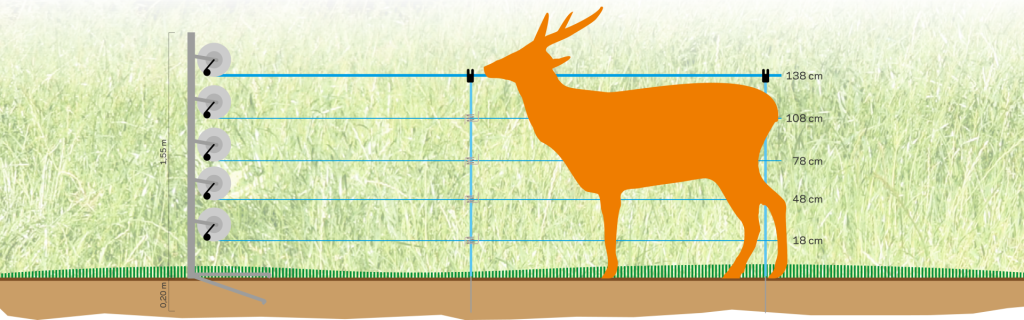
Damage caused by wildlife is a recurring problem for an increasing number of both livestock and arable farmers. The risk of damage to crops and farmland increases as crops develop. Young plants contain high levels of sugar, making them increasingly attractive to rabbits and deer. Badgers are also drawn to pastures where they can root around in the crops and soil in search of food.
Yet the risk of wildlife damage is often accepted. In practice, action is only taken once damage has already occurred. “As long as nothing has gone wrong, the risk is often simply accepted,” says Kees de Krom, Field Expert at Gallagher. “It is only after the first damage occurs that farmers start thinking about prevention. If there is food to be had and there is no physical barrier, wildlife will always find its way onto the pasture.” Without effective fencing, the risk of crop loss increases significantly. The question, therefore, is not whether things will go wrong, but when.
Consequences of wildlife damage
When crops are partially or completely eaten or trampled by wildlife, this has direct financial consequences. The yield from the pasture decreases and income is lost. That loss is permanent for that season.
In addition to the financial impact, frustration also plays a major role. Not only because of the damage itself, but mainly because in many cases this damage could have been prevented with timely preventive measures.
In other situations and sectors, such as golf courses and sports fields, preventive protection against wildlife is becoming increasingly common. “If a badger churns up a golf course, it’s not just about repair costs,” says De Krom. “A hole or parts of the course are often unavailable for a long time. That is precisely why you see prevention increasingly becoming the norm rather than the exception. Not because it is mandatory, but because it works in practice.”
Where the consequences of damage are significant and visible, there is less hesitation and a greater tendency to opt for prevention. This underlines that wildlife damage is not an occasional problem, but a risk with lasting impact.
What makes a wildlife fence effective
Keeping wildlife out of a pasture requires a different approach to keeping livestock within a pasture. This distinction is important for understanding why some fences do not have the desired effect.
Livestock are familiar with the electric fence. The food is inside the pasture, so there is no reason to breach the fence. Combined with their habituation to the electric fence, the fence primarily acts as a boundary. With wildlife, the situation is different. Wild animals have no experience of an electric fence and are, in fact, attracted by the food located behind the fence. As a result, deer and Badgers are motivated to get through the barrier.
“In practice, a wild animal often only comes into contact with a fence once or twice,” says De Krom. “That first experience is therefore decisive. If the shock is powerful enough, the animal learns that this area is not an accessible food source and will avoid it. If that experience is too weak, there is a high chance that the animal will keep trying and will start seeking out the pasture on a regular basis.”
A minimum voltage of 4.5 kV is therefore necessary for deterring wildlife. Wild animals often have thicker fur, so the initial shock must be powerful enough to actually deter them. At the same time, it is important that the animal also recognises the fence. Wildlife is often active at dusk, and blue electric fence is more visible in those conditions. This allows the animal to immediately associate the shock with the fence and learn that this barrier cannot be crossed.
The various wildlife fencing solutions for preventing wildlife damage
Suddenstrike Fencing offers various solutions to deter wildlife. In practice, the choice mainly comes down to temporary or (semi-)permanent fences, depending on how long protection is required.
A temporary fence is suitable when a crop is in the field for a single season. The fence provides protection for as long as the crop is present and can then be easily moved or removed. In practice, this often involves using a reel corner post with multiple wires, typically with five wires positioned at heights between 10 cm and 138 cm. Heights vary depending on which species you have the problem with in your area.
A (semi-)permanent fence is a better choice when a pasture faces an annual risk of wildlife damage. This applies particularly to fixed locations or perennial crops where wildlife is structurally active. This solution is often constructed using Line Post posts in combination with high-tensile wire and blue tape, with six wires at heights between 10 cm and 135 cm.
Wire mesh is often considered to keep animals in but it wont keep animals out. It does not teach wildlife to avoid the pasture and is therefore less effective. An electric fence combines a physical boundary with a deterrent effect, causing animals to recognise the pasture as a place where no food can be found.
Would you like more insight in to fencing solutions to keep wildlife out?
If you would have any further questions or would like to discuss how Suddenstrike Fencing can assist, please lease contact a member of the Suddenstrike Fencing team on 01270 619147 or mail@suddenstrike.co.uk and we will be happy to answer any of your questions.
In other news...
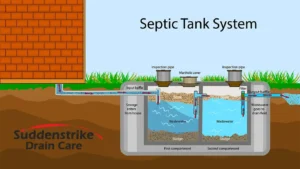
All you need to know about septic tanks and septic tank regulations
What is a septic tank used for? If you do not have access to a mains drainage a septic tank provides a traditional option to dispose of sewage for domestic dwellings. A septic tank is an underground wastewater chamber, that is designed to settle and retain solids from a property. The solids sink to the…
- « Previous
- 1
- …
- 4
- 5
- 6